Author:
Daniel Hayes
Director | Operations & Testing | Acoustic Research Systems


Author:
Cassandra Dutt
Staff Project Engineer
 Share Article


Applying Aerospace Quality Standards to DFAN Testing
Direct Field Acoustic Noise (DFAN) testing has its heritage in touring concert audio. Until recently, all the sound generation equipment, such as speakers, amplifiers, and cabling, consisted of modified concert gear. There have been anecdotes of confetti shooting out of speakers or speakers carrying mud from an outdoor festival the week before testing. The early years of Direct Field Acoustic Noise (DFAN) testing undeservedly warped some people’s perceptions of Direct Field Acoustic Noise (DFAN), that it is just a bunch of roadies. However, widespread industry acceptance of the test methodology has since significantly expanded the possibilities for Direct Field Acoustic Noise (DFAN).
When ARS was formed, a guiding principle was to make ARS an aerospace company with expertise in audio and not the other way around. We aimed to understand the needs of the industry, and part of that was aligning with the aerospace way of doing business. That includes applying the concept of quality to ARS and our products and services through a Quality Management System (QMS). Our attention to detail and aerospace professionalism are just some applications of how we apply quality at ARS.
What does quality mean to us at ARS? A simplified answer is that quality gives us a framework to enable operational excellence to maintain customer satisfaction. Quality can be applied to every aspect of a business. Two aspects of our business that highlight quality are the system design, test preparation, and execution.
From the beginning, ARS has designed its system to incorporate risk reduction principles. This led to a clean-sheet design for the Neutron™ speaker. Legacy concert speakers, and those derived from them, are not adequate for Direct Field Acoustic Noise (DFAN). We were able to design exactly what is needed for our application while adding features that wouldn’t be feasible with a concert-type loudspeaker system. Industry-leading suppliers were used to help design and build the system using aerospace-conforming materials and quality control.
To further our mission of simplicity and efficiency in setup, we employed a Poka-Yoke approach to designing our Neutron™ System assembly process. Poka-Yoke is a Japanese term that means “mistake-proofing” or “inadvertent error prevention”. A poka-yoke is any mechanism in a process that helps an equipment operator avoid (yokeru) mistakes (poka) and defects by preventing, correcting, or drawing attention to human errors as they occur.
Some examples of this in our Neutron™ system design are:
- Uniquely keyed main power connectors to ensure that improper power connections cannot be made.
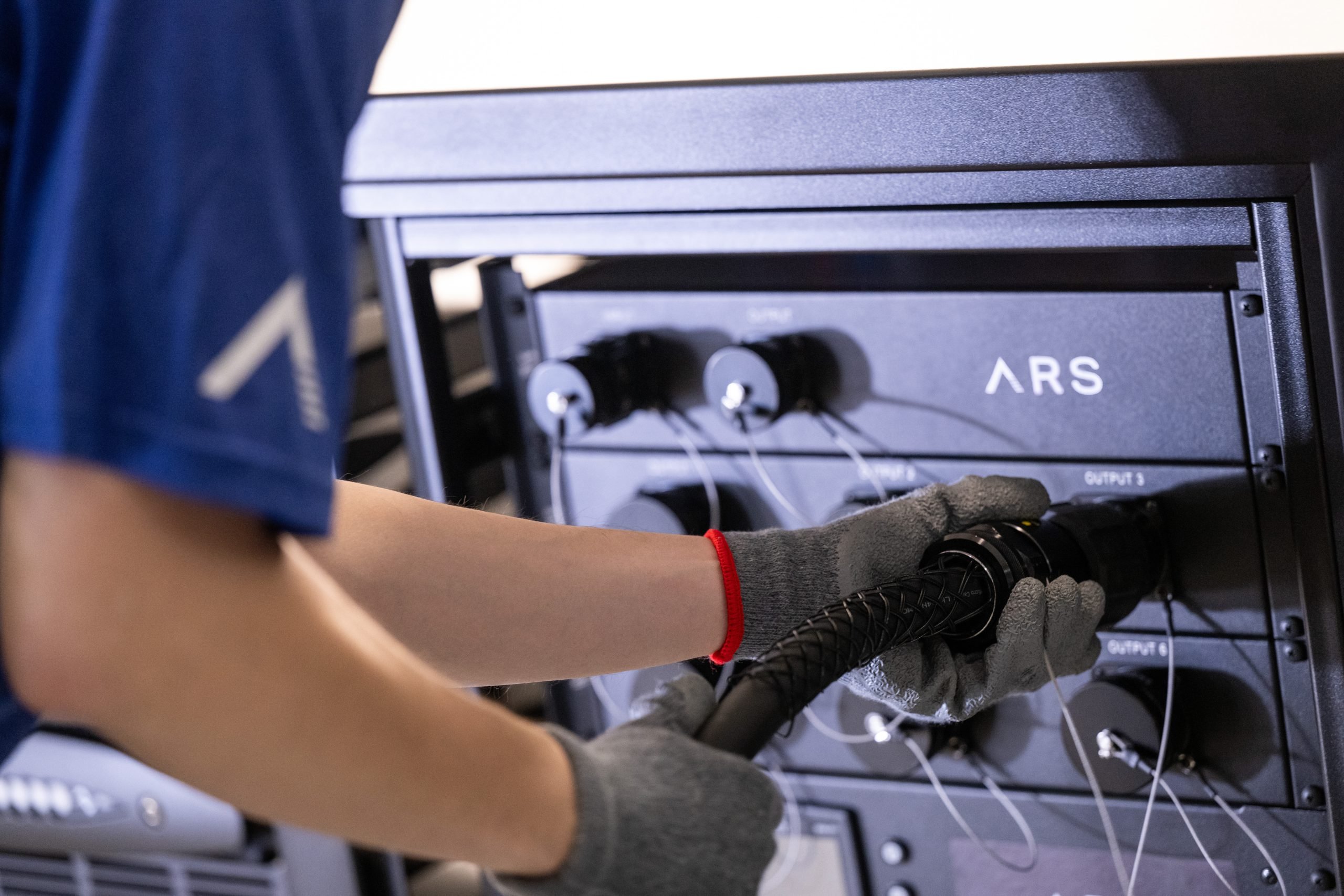
- Unique signal connectors that ensure only the right type of connector can be used for its respective signal transport role.
- Complex patching operations are pre-wired in our ARS Drive, and only single-point connections need to be made by the operator onsite.
- A Neutron™ is driven by one amplifier, and they are connected by one cable.
- Thorough manufacturing documentation to communicate proper operations and maintenance of the system.
This ensures our proprietary system is set up quickly and efficiently and that the probability of making unsafe or improper connections is significantly reduced and nearly eliminated.
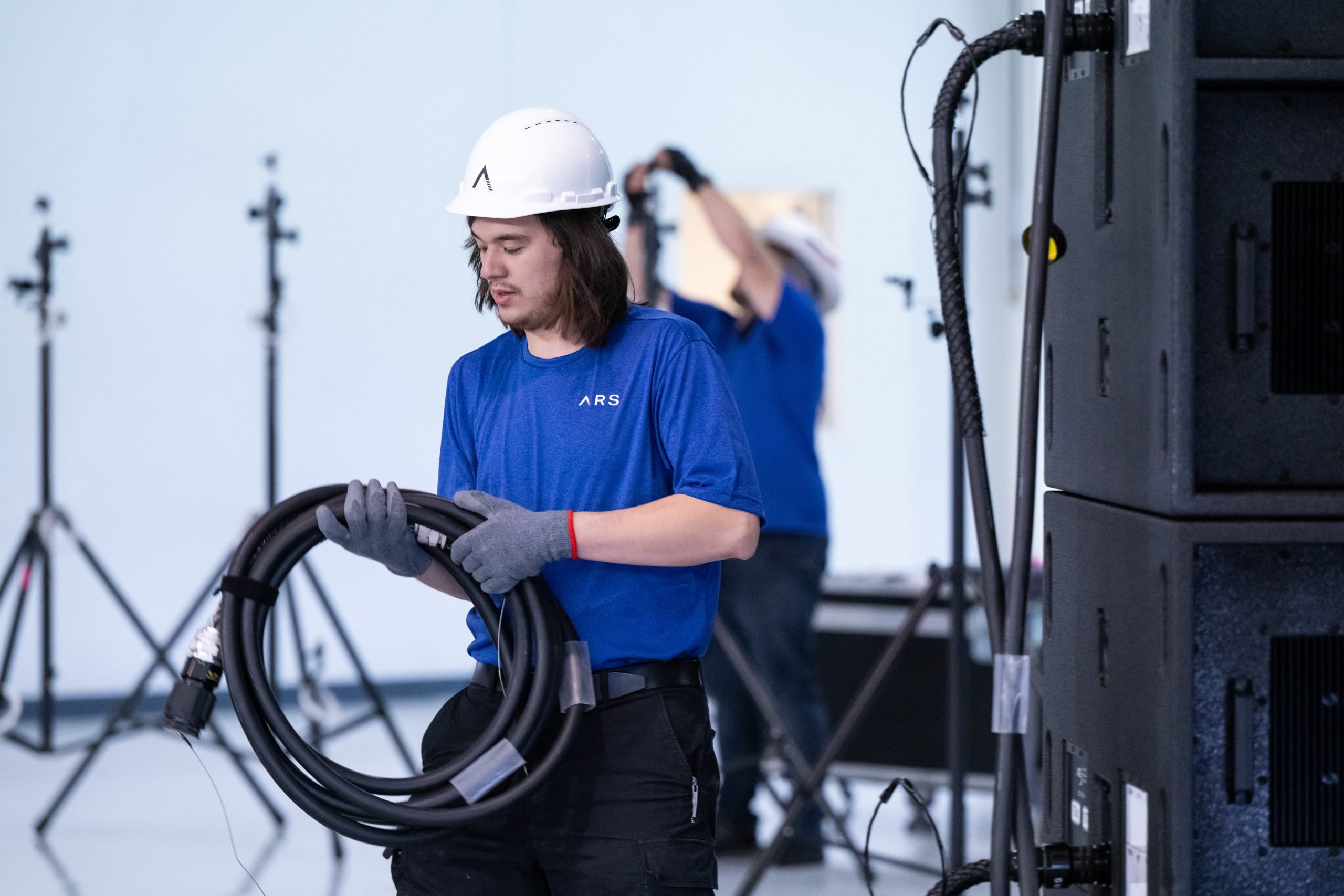
Quality standards are also heavily applied during test preparation and execution. ARS always uses client- and peer-reviewed released test procedures and test configuration drawings. The test procedure especially is a crucial error prevention tool. It guides all aspects of the test setup and execution and serves as the main record-keeping tool during the test. The test procedure also directs the use of pre-task briefings. ARS’s standard is to hold a pre-task briefing before each crane operation or test run. These briefings follow a structured format that provides a forum for issues to be presented. All ARS test execution uses the “Second Set of Eyes” technique to add another layer of error proofing. Our goal is to think through problems before they occur and develop mitigation strategies that can be deployed as needed.
While ARS values efficiency, we reject the “go fever” often associated with roadies. We avoid making impulsive decisions, particularly during troubleshooting. We are linear and structured in our troubleshooting methodology. You risk getting rid of evidence of the root cause if you don’t follow set procedures. If an issue happens, ARS strives to be able to tell the client what the problem is, how we can fix it, and why that is not a risk to the flight hardware or personnel and facility.
Ultimately, our goal is to enhance the safety of personnel and flight hardware. Everyone at ARS is committed to delivering a quality product and service.