Author:
Dale Schick
Director of Applications

 Share Article


Cleanliness in DFAN Testing
Why Cleanliness in Space?
When our earthbound minds wander, we often think from the only perspective we know. Be it about human things like food, family, or friends, to more ‘out there’ topics like sound, science, and space; we tend to apply worldly boundary conditions whenever possible. Dirt is dirty. Washed hands are clean. A fingerprint is a fingerprint. In space, however, a fingerprint can be a hazard, outgassing for an undetermined period and depositing cloudy vapors onto sensitive equipment, potentially damaging an entire mission.
An earthly example of this? Think back to a nice chilly and sunny morning. You hop in your car and gaze through the windshield, newly fogged with your heavily huffing breath. On with the defroster to get rid of that pesky condensation! This works wonders by forcing dry heated air onto the windscreen, vaporizing the condensation and restoring transparency to your morning commute. Until, that is, you round a corner and catch the sun on the newly liberated windscreen, only to find a foggy layer of blinding contamination.
The source of this contamination? Outgassing volatile compounds in the vinyl dashboard that slowly deposit on the nearest surface. To vaporize these compounds, the windshield would need to be heated to levels beyond the safety of your earthly vehicle. Thankfully, a cloth and some glass cleaner will do the trick. For now.
For non-earthly vehicles, like satellites and space habitats, the environmental extremes are much more, well, extreme. Depending on their position in our solar system, component temperatures can be similar to earth at -10 to 45 degrees C; to a more outrageous -269 to 100 degrees C. Couple these temperatures with the harsh vacuum environment in space, and all of our earthly conceptions of simple things, like a fingerprint from a freshly washed hand, get turned upside down.
Controlling Contaminants in the Laboratory
Due to the sensitivity of critical components on spacecraft, laboratories and manufacturing facilities go to great lengths to protect their precious cargo. Ironically, humans just hanging around are a risk. Breathing, shedding hair, circulating epithelial waste in our own little convection systems fueled by excess heat escaping our heads— we are a mess! Protecting the spacecraft from our filthy little ecosystems requires uncomfortable garments like gloves, bouffants, beard covers, and even full bunny suits in some cases to contain everything in one place. Anyone who has donned this protective apparel understands the irony of needing a shower after a full day in a cleanroom.
There also exist protective environments for spacecraft, which are threatened by even the pollen in the air, and these can vary wildly in complexity and, subsequently, efficacy. The aforementioned cleanroom is the most common and works by combining air-filtration components with forced-air systems to remove many of the common particulates in the air.
When space components or structures are required to travel outside of the safety of the cleanroom, they sometimes wear a sort of garment of their own. A well-fitted electrostatically dissipative bag can be used and is sometimes even filled with a positive-pressure environment of a clean and dry gas, like nitrogen, to keep contaminants from seeping in. This sometimes opaque and shimmery material makes for both a functional and elegant space gown indeed.
Creating a Better DFAN Test
In the business we occupy, launch vehicle acoustic qualification using the Direct Field Acoustic Noise (DFAN) method, there are also risks for contamination. Namely, sound equipment may be stored in unclean environments, bringing surface contamination near spacecraft. Cables can be dragged on the ground, stirring up particles. Drivers may be destroyed, bellowing smoke containing volatile particles toward precious spaceflight hardware.
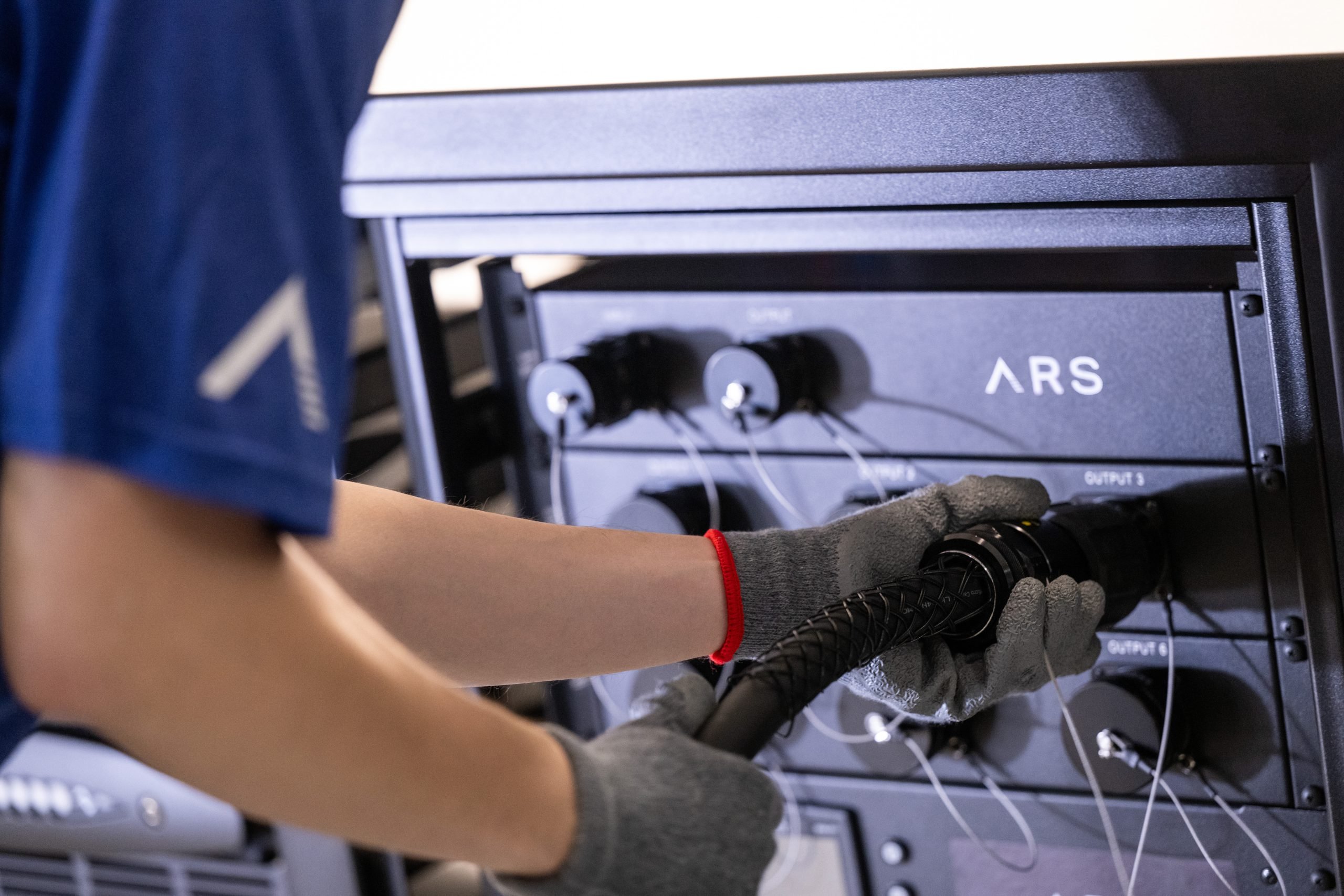
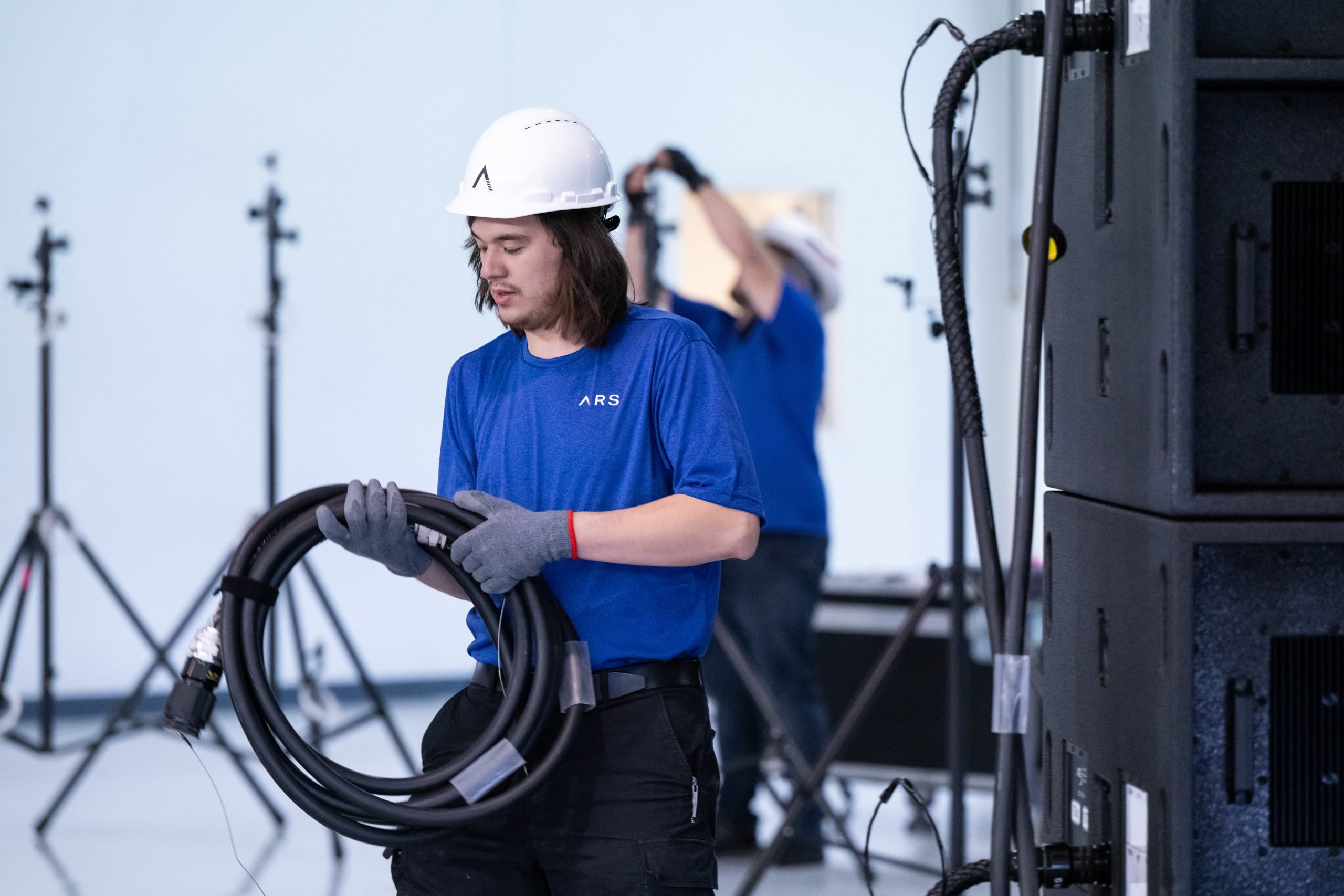
Thankfully, in the design phase, ARS originally consulted with industry professionals who have experienced nearly every conceivable contamination risk before creating the Neutron™ testing system. We avoid exposing the equipment to concert and festival environments by purpose-building them for acoustic testing only. Cable surface area is minimized by reducing the number required for testing to just one per device and using military specification connectors for all terminations. The unparalleled efficiency of the Neutron™ components means that not a single Neutron™ driver has ever ‘cooked’ itself during a test. Ever.
Even with these mitigations in place, the level of cleanliness in the cleanroom is hard to recreate outside of one, so we offer an added layer of protection by professionally cleaning and sealing each component for transport. The transition from the shipping container to the cleanroom environment with this additional service layer offers a huge advantage over renting concert equipment, which is just as likely to spew confetti from the last New Year’s Eve party as it is to generate a sound field.
Controlling Contaminants in DFAN Testing
One feature of DFAN testing is that it travels to the component, providing some options in terms of placement. When cleanliness is a concern, it’s often the case that the DFAN system ends up directly in a cleanroom environment. Precleaning can help with the more transient components needed for a test, but what happens when a calm, quiet cleanroom gets a sudden blast of rumbling acoustic energy meant to simulate a rocket launch?
A lot, apparently. Dust and particulates can settle everywhere, even in a cleanroom: on top of stationary equipment, inside small crevices, and even on the walls themselves. It’s not uncommon for particulate counts to jump well above acceptable levels, if only temporarily, during an acoustic test simply because the dust particles rattle loose from their comfortable homes. Special particulate fire alarms can even be fooled into a triggered state, so we’ve had to disable them and rely on manual fire watch, if only for a few minutes. Luckily, the ‘deep clean’ provided by the acoustic test produces fewer particles with each subsequent run as the cleanroom does its intended duty of removing particles. Performing one or two pretest runs without the test article can be a good way for the dust to settle, literally, before introducing the test article to the environment.
When a cleanroom environment isn’t available or feasible, testing in an unrated high-bay is a good second choice. In this case, it may be time for the spacecraft to suit up! But wait. Doesn’t that affect the transmissibility of the acoustic field? I mean, wearing a bag over your head would certainly affect how you perceive the world from an aural perspective, right?
I asked the very same question when working on the other side of the industry during a previous life in spacecraft manufacturing. We conducted a small test with a brand-name 3-mil translucent metallic film, a sound source, and a couple of microphones. This test was intended to discover what the spacecraft hears on the other side of the bag, so to speak. Thankfully, only minimal attenuation occurred at frequencies above 5 kHz, which is well above the region considered in mechanical dynamic excitation. For smaller components that might be sensitive to such frequencies, like printed-circuit-board-mounted oscillators, a simple bump of 1 or 2 dB at these frequencies would take care of any attenuation the bag may provide.
Conclusion
Unlike many who were born with a Saturn V model rocket in hand, I found my way into a fascination with space later in life. As a child, I spent a lot more time playing with earthly things like cars, footballs, hockey sticks, and the occasional video game. Apart from being a natural clean freak, it’s been wild trying to adapt my perspective and consistently being surprised by the fascinating physics of space. I hope this article helps someone else discover a similar fascination, even if just by looking through their car’s windscreen on a sunny morning.