Author:
Daniel Hayes
Director | Operations & Testing | Acoustic Research Systems


Author:
Cassandra Dutt
Staff Project Engineer
 Share Article


Microphone Support Systems That Safeguard Your Mission
Microphone placement is critical to reliable DFAN testing. The ARS Microphone Support System (MSS) ensures that microphones are positioned safely, accurately, and consistently, removing risks while supporting mission assurance.
Placement Without Compromise
The ARS Microphone Support System (MSS) allows microphones to be placed in hard-to-reach or hazardous areas, such as directly over flight hardware. Traditional microphone stands lose stability when their height or reach is extended, creating limitations for accurate placement. By contrast, the MSS enables microphones to be positioned securely with minimal interference to the test article.
Reducing Test Floor Hazards
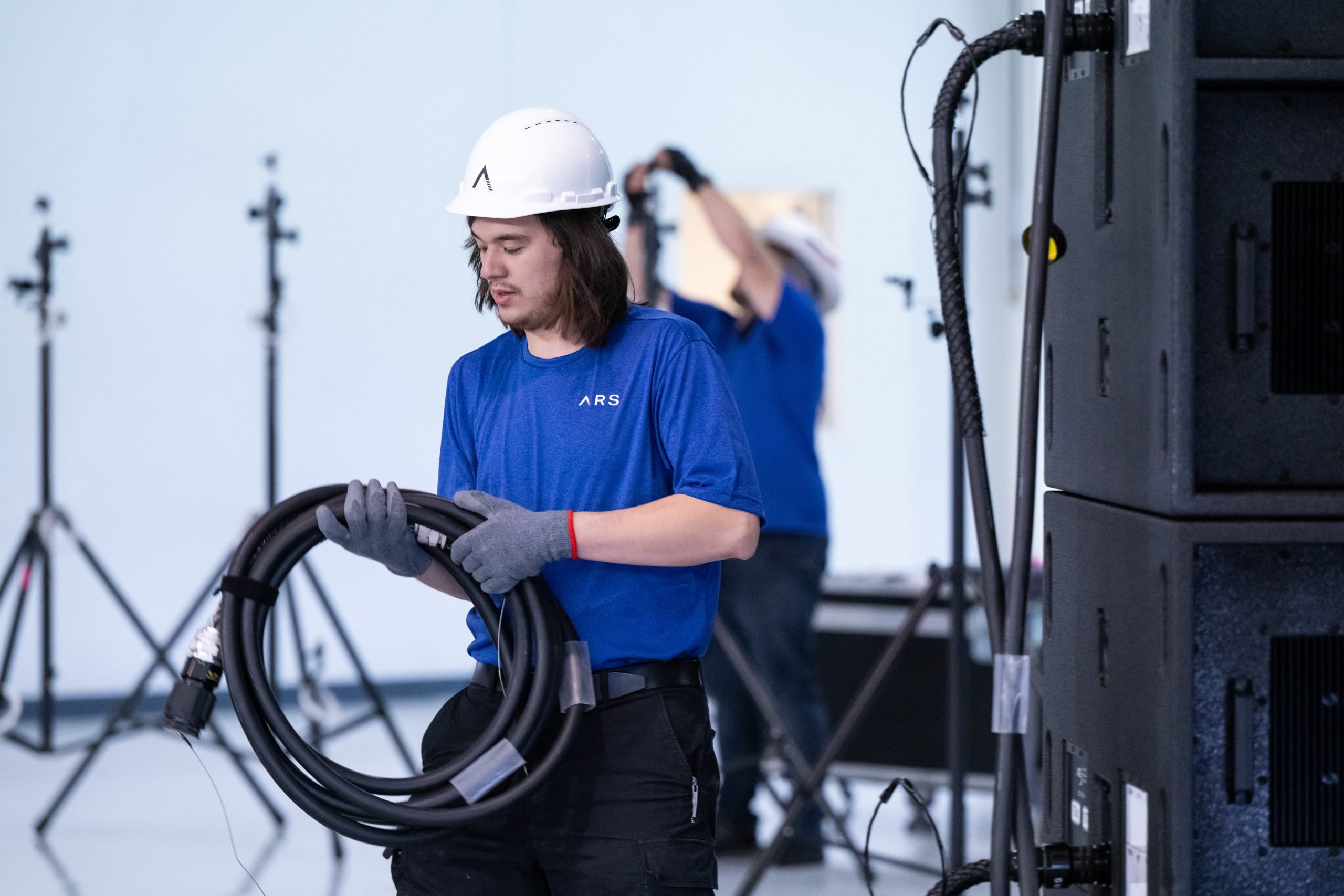
Traditional microphone stands require wide and often weighted bases to maintain stability. These bases obstruct access, introduce tripping hazards, and can topple if bumped by test personnel, posing risks both to people and to the test article itself.
The ARS standard is to mount as many microphones as possible to the MSS rather than relying on individual stands. This practice reduces hazards, clears floor space for critical flight hardware activities, and enhances overall test safety. Every MSS component is tethered directly to a Neutron™ structure, further increasing stability and lessening risk to flight hardware.
Accuracy by Design
Verifying the exact three-dimensional placement of a small microphone relative to a test article is both challenging and potentially hazardous. The MSS addresses this by fixing microphone positions directly to each Neutron™ stack. Each stack is then positioned in a known configuration relative to the test article. This eliminates the need to measure article-to-microphone distances as those relationships are already defined.
ARS builds DFAN systems from the top down in modular building blocks. Microphone placement is defined per block, which allows multiple blocks to be combined in a consistent geometry. This approach ensures accuracy across simple or complex configurations alike.
Confidence in Every Set Up
A key consideration during DFAN testing is how the test article will be moved inside the speaker circle. For safety reasons, ARS avoids constructing a DFAN system in direct proximity to the test article. Once the circle is built, it must be opened to allow the article to be positioned.
With traditional floor-based stands, this would require moving multiple stands one by one, carefully recording and re-verifying each position and height before and after the article is placed. Repositioning every stand introduces significant inefficiency and the potential for human error.
The ARS MSS eliminates these issues. Because microphones are fixed to the Neutron™ stacks themselves, they move with the stacks and retain their defined placement. This ensures repeatability, reduces setup time, and minimizes risk. The same test setup can be reproduced reliably across campaigns, yielding consistent and dependable results.
Mitigating Risk, Building Confidence
At its core, the ARS MSS is designed for risk mitigation during the instrumentation of flight articles. It improves access, enhances safety, ensures precise placement, and enables repeatable test setups – even for the most complex campaigns.
By integrating safety, accuracy, and repeatability into one system, the ARS MSS strengthens mission assurance from setup through launch qualification.