Share Article


The Infrastructure Securing the Space Domain
Modern security infrastructure depends on systems most people never see. Signals crossing oceans. Secure communications between governments and defense networks. Navigation systems supporting military coordination and emergency response. Satellites monitoring activity across vast geographic regions in near real time.
Much of this infrastructure operates quietly in the background, but its role has become increasingly central to how nations maintain continuity, situational awareness, and resilience. And increasingly, those capabilities depend on space.
Space as Strategic Infrastructure
Space-based systems have become deeply integrated into national security operations. Satellite communications support secure data transmission across regions where terrestrial infrastructure may be unavailable, disrupted, or vulnerable. Earth observation systems contribute to monitoring environmental events, maritime activity, and infrastructure changes. Navigation and timing systems underpin logistics, coordination, and synchronization across civilian and defense networks alike.
This dependence has grown significantly over the past decade as governments expand investments in space resilience and orbital infrastructure.
Organizations such as the United States Space Force, North Atlantic Treaty Organization, and allied national space agencies have increasingly emphasized the importance of protecting space-based assets as part of broader security strategy.
At the same time, commercial systems are beginning to play a larger role. The widespread use of commercial satellite communications and Earth observation capabilities during humanitarian crises and regional conflicts has highlighted how space infrastructure now supports both military and civilian continuity in ways that were less visible a decade ago.
A Shift Toward Resilience
The discussion around national security space systems has also changed. Historically, many security-focused satellites were designed as highly specialized, limited-number assets operating in higher orbits. Increasingly, however, governments and commercial providers are moving toward more distributed architectures designed around resilience and redundancy.
This includes proliferated low Earth orbit constellations, diversified communication pathways, and systems designed to continue operating even if individual assets are disrupted.
The Space Force’s Space Development Agency are helping drive this shift through initiatives focused on resilient orbital networks and missile warning architectures operating across distributed constellations. The emphasis is increasingly moving from protecting single systems to ensuring continuity across entire networks.
Why Reliability Becomes Critical
As security infrastructure becomes more interconnected, the consequences of failure become more complex. Unlike purely commercial systems, national security architectures often operate under conditions where interruption is not simply inconvenient. Communication latency, degraded positioning accuracy, or interruptions in surveillance coverage can affect operational coordination and response capability.
At the same time, many of these systems are expected to operate continuously for years in orbit while maintaining precise and reliable performance. That creates very little tolerance for uncertainty.
The Demands of Launch
Despite advances in spacecraft design and orbital architecture, every satellite still faces one of its most demanding environments before it ever becomes operational.
During launch, spacecraft are subjected to intense acoustic energy, vibration, and dynamic loading that can influence structural behavior, sensitive payloads, and long-term system performance.
For national security systems, where reliability and continuity are fundamental requirements, understanding how spacecraft respond during ascent is essential.
A problem introduced during launch may not appear immediately. In some cases, it may only emerge later through degraded performance, shortened operational life, or reduced system reliability.
As orbital systems become more interconnected and strategically important, reducing that uncertainty before launch becomes increasingly critical.
Where Operational Confidence Begins
Long before a secure signal is transmitted or a system begins supporting operations in orbit, much of its reliability is established on the ground. Environmental testing allows engineers to evaluate how spacecraft structures and payloads respond under launch conditions, helping validate performance before deployment. The objective is not simply survivability, but confidence that systems will continue operating as intended once in orbit.
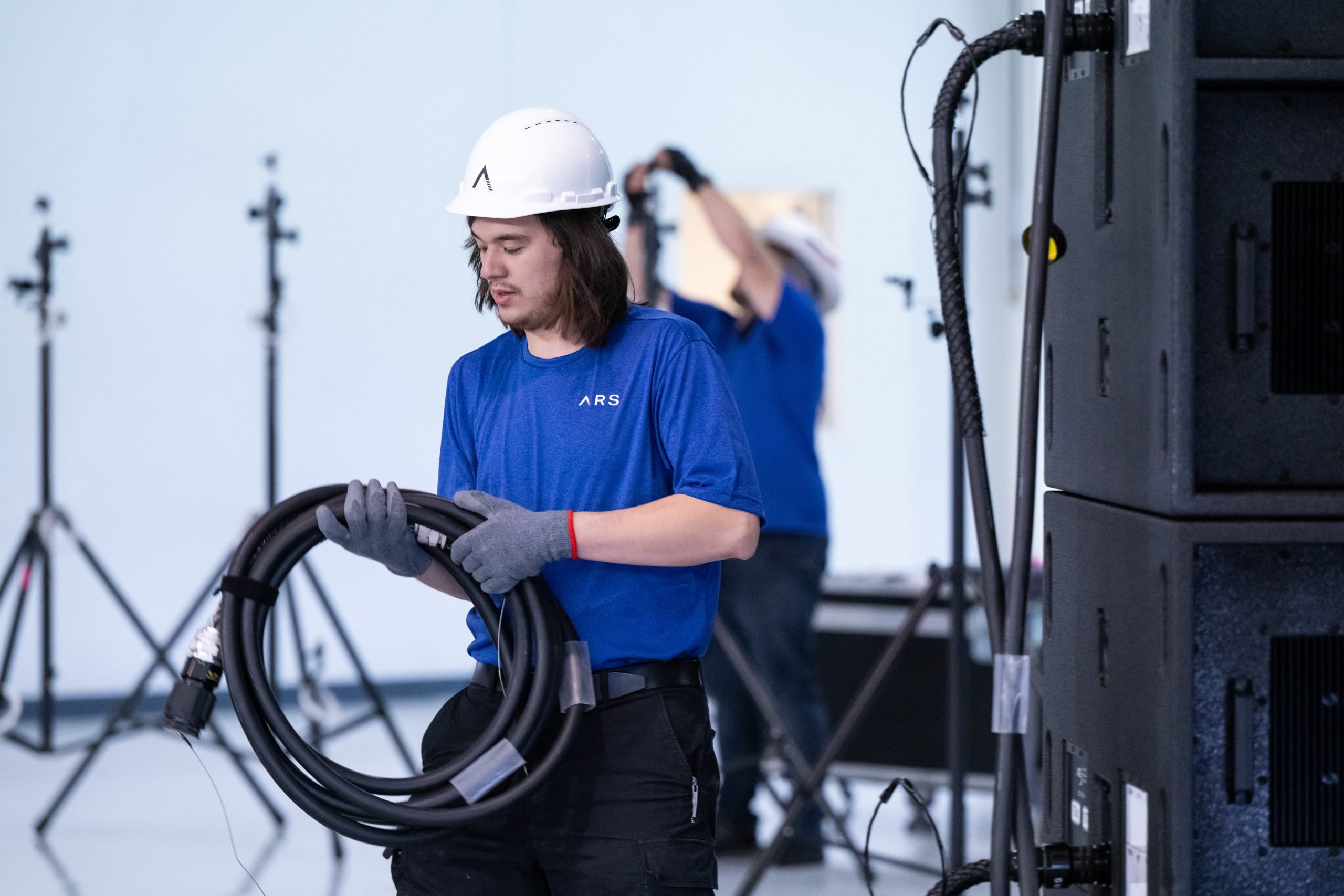
At ARS, acoustic testing systems are designed specifically to replicate these ascent demands, forming part of a broader mission assurance effort. As space-based infrastructure becomes increasingly central to communications, coordination, and security, confidence in system performance begins long before launch. Because in security infrastructure, continuity depends on systems that can be relied upon without interruption.
Why Space-Based Security Infrastructure Matters
Space-based security systems influence far more than defense operations alone. They support disaster response, maritime safety, emergency communications, navigation continuity, and infrastructure resilience across civilian and governmental networks. In many cases, the same orbital systems supporting national security operations also contribute to maintaining stability during natural disasters and humanitarian crises.
As reliance on space infrastructure continues to expand, the importance of resilient and reliable systems will continue growing alongside it. And while much of that infrastructure operates far beyond public view, its role has become foundational to how modern societies communicate, coordinate, and respond.