Author:
Riley King
Intern: Testing & Operations

 Share Article


More than Just Noise: My ARS Internship Experience
As the summer comes to an end and my senior year at The Ohio State University approaches, I have taken the opportunity to reflect on my internship with Acoustic Research Systems (ARS). This experience has reshaped the way I think about engineering and the direction I want to take in my career.
As an Aerospace Engineering major, I spent last fall applying to internships at the kind of places you’d expect, large contractors, research labs, and other well-known organizations in the field. After submitting more than 30 applications and hearing little in return, I came across the Keystone Space Collaborative. This group is dedicated to growing the aerospace industry in Pennsylvania, West Virginia, and Ohio. While scanning through their partner companies, I stumbled upon ARS.
At first, I wasn’t sure how a company focused on acoustic testing fit into the aerospace industry. I assumed that if something was built to survive spaceflight, it could handle a bit of noise. But as I explored ARS and their work in Direct Field Acoustic Noise (DFAN) testing for payloads, I realized that sound during launch is not just background noise. Sound is energy, and in a launch environment, that energy can damage sensitive equipment if not properly managed. Once I understood that, I knew I wanted to reach out.
Not long after I reached out through the website, Jeremiah Leiter (CEO) responded and connected me with Dann Hayes to help me learn more about the company. Their responsiveness was a breath of fresh air after weeks of hearing nothing back from other companies. I was soon invited to visit the hangar and see the Neutron™ in action. That visit convinced me that I wanted to be a part of their organization. It wasn’t just the power of the Neutron™ that impressed me, but the people. Everyone I met at ARS was genuinely interested in investing in young engineers and helping them grow in the industry.
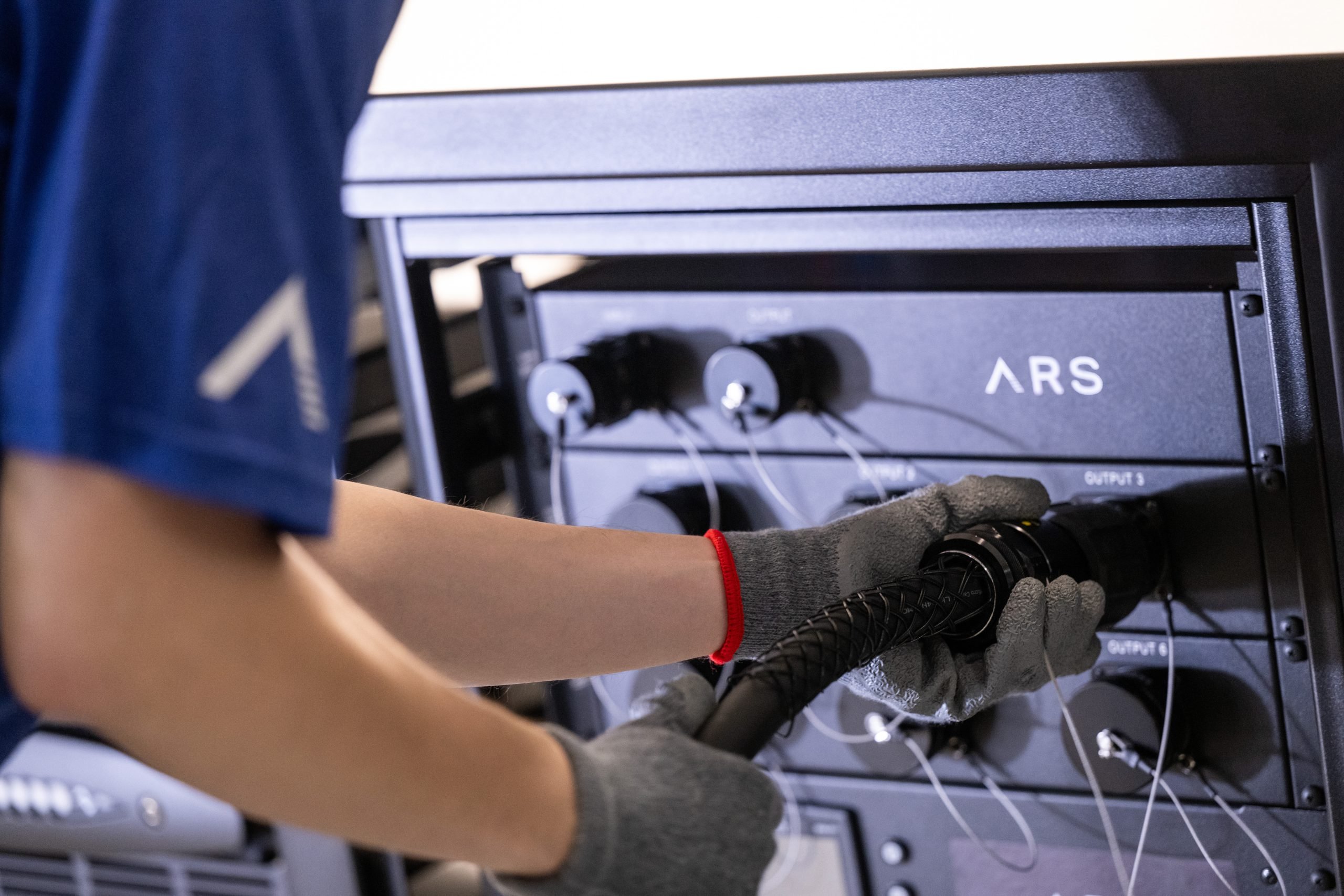
My first week with ARS began with a study at NASA Langley. I was immediately immersed in hands-on work, learning everything from how to wrap and label cables (buddy tabs are a must) to the fundamentals of sound pressure level (SPL) and how to approach a test like an engineer. The pace was fast, and sometimes overwhelming, but it was also incredibly educational.
Coming from an educational background focused heavily on theory and math-fluid dynamics, propulsion, orbital mechanics– this experience was a major shift. At ARS, I saw what it means to be an engineer in practice. I learned how to conduct real-world testing, how to set up systems for success, and how to document and communicate results clearly.
When I wasn’t at the hangar, I worked on technical writing and safety procedures. These tasks taught me how to explain complex processes in a way that makes sense to people with different backgrounds. I came to understand that one of the most valuable skills in engineering is the ability to communicate clearly. Whether I was writing a hearing conservation plan or a procedure on how to fix a problem, I found that explaining something well helped me understand it better than studying equations or theory ever could.
Something that stood out to me a lot during the internship was realizing how acoustics and aerospace are connected. DFAN testing is just one example. Launch noise also affects nearby communities, making sound a critical factor in aerospace design and operations. This topic had never come up in my studies, but now I see its relevance everywhere. Stepping outside of my academic comfort zone helped me discover an entirely new aspect of this field.
This internship gave me more than technical experience. It expanded my perspective. I now have a deeper appreciation for how diverse and collaborative the aerospace industry is and how valuable it is to work alongside people who are passionate about what they do. I could not have asked for a better way to spend my summer, and I am excited to continue to develop everything I have learned.